Mountains & Dunes
Ride details
Price
1250 €
Level
for experienced riders
Group
max
12
riders
Available dates
Additional costs
Flights, lunches on the way to Zagora, Marrakech and Aït Ben Haddou, entrance fees, insurance
Day 1 — Marrakech
You land in Marrakech — one of the most intense cities in Morocco. From the first moment, it hits you: carpets, spices, leather, endless stalls, coffee, sweets, snake charmers, noise, voices, horns.
Narrow streets, street food, piles of fruit, rows of olives.
Everything revolves around Jemaa el-Fna — this is where your time in Morocco begins.
You have time to explore on your own. If you want to see a few of the key spots, we recommend the Saadian Tombs, Majorelle Garden, Bahia Palace, and Le Jardin Secret. It’s worth choosing in advance — Marrakech pulls you in, and it’s hard to do everything.
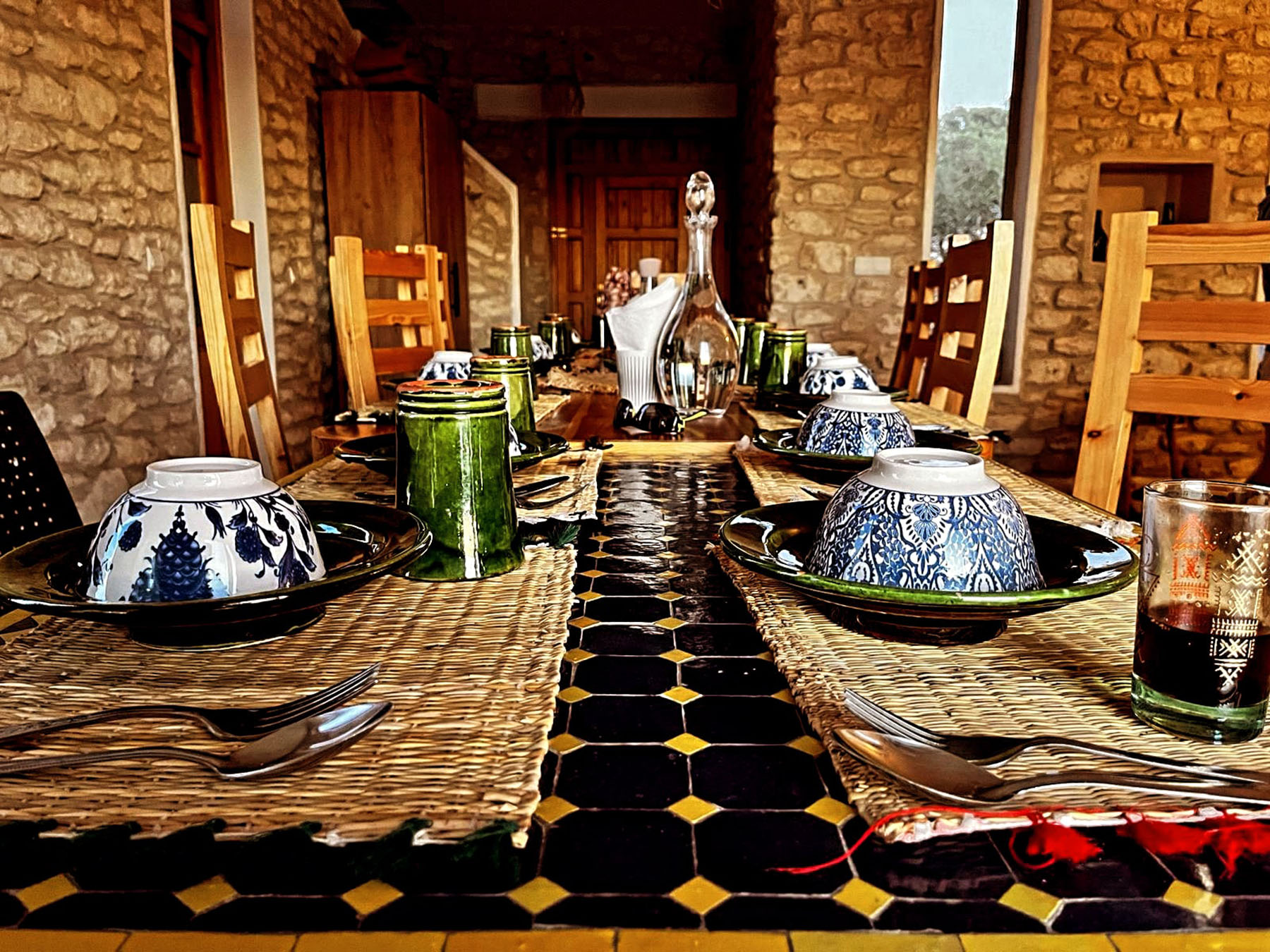
In the evening, we return to the riad. Moroccan dinner, time to rest, and a first moment to settle into the place.
Day 2 — Towards the Atlas and south
The journey really starts here. We head south into the Atlas Mountains, leaving the cities behind and moving into a more raw side of Morocco.
Ahead of us is the Tizi n’Tichka pass, over 2000 m above sea level. Winding roads, sharp turns, big changes in altitude. It’s one of the most scenic routes in the country — but also demanding. If you’re prone to motion sickness, it’s worth being prepared.
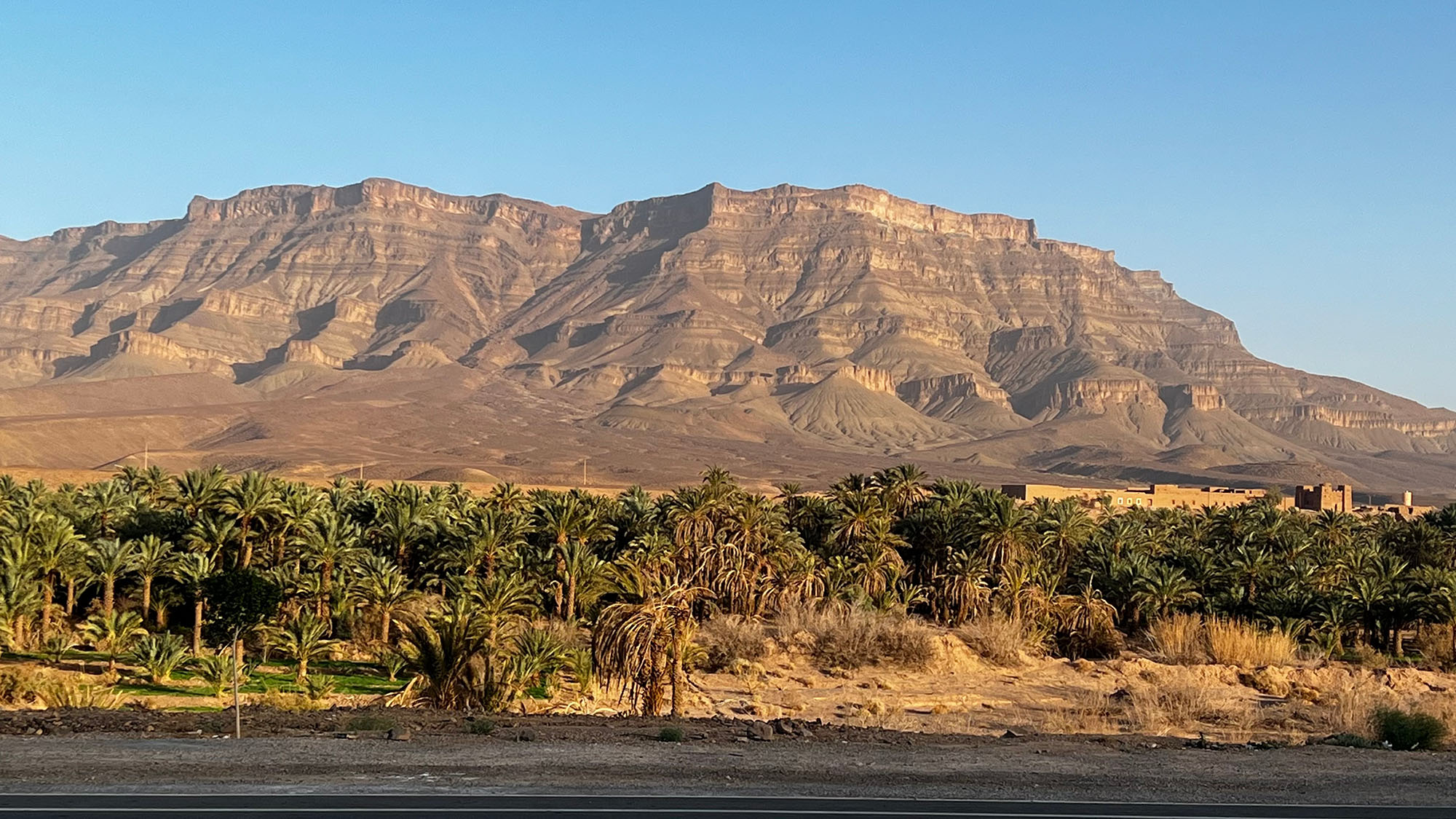
As we go, the landscape shifts. The mountains become more rocky and wild. Natural passes and gorges appear, and lower down — green valleys with almond trees in bloom, palm groves, and clay houses clinging to the slopes.
This is the point where you really feel we’re heading towards the Sahara.
Our destination is Zagora — the town where we run our stable in the winter season, and where the desert routes begin.
We stay in a hotel for the night. Dinner, and time to rest after the drive.
Day 3 — First day in the saddle
After breakfast, we get on the horses. A long day out ahead.
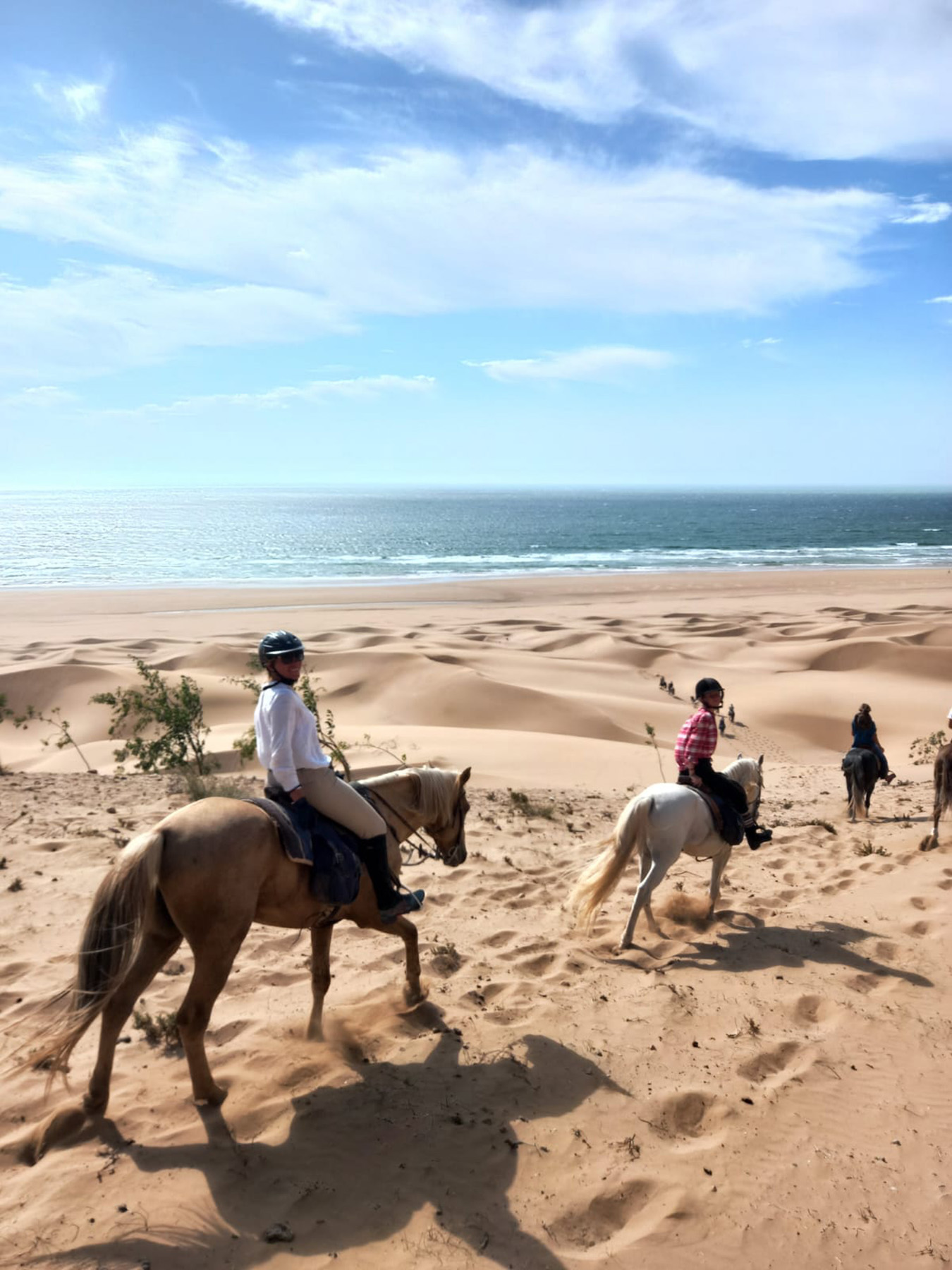
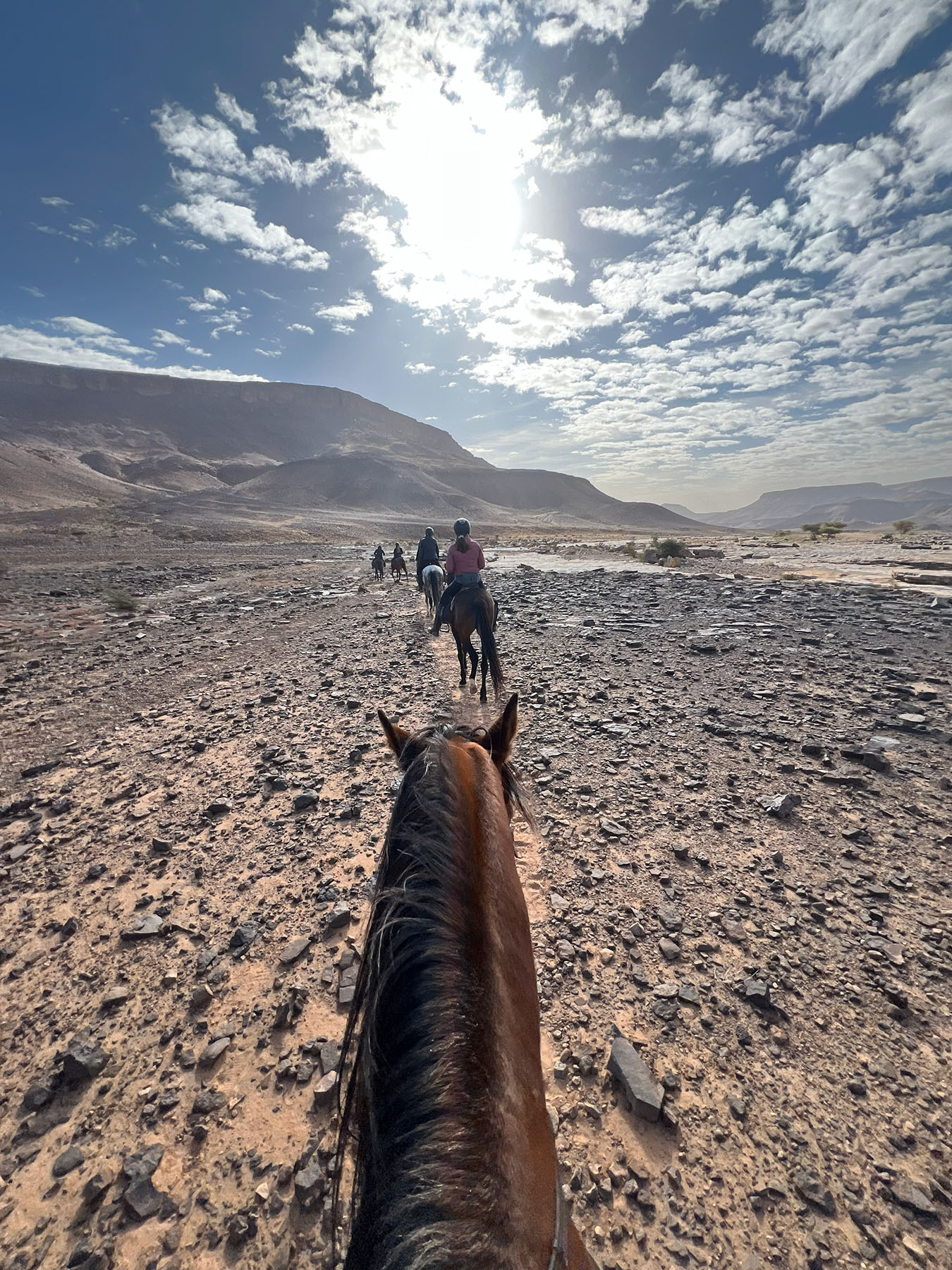
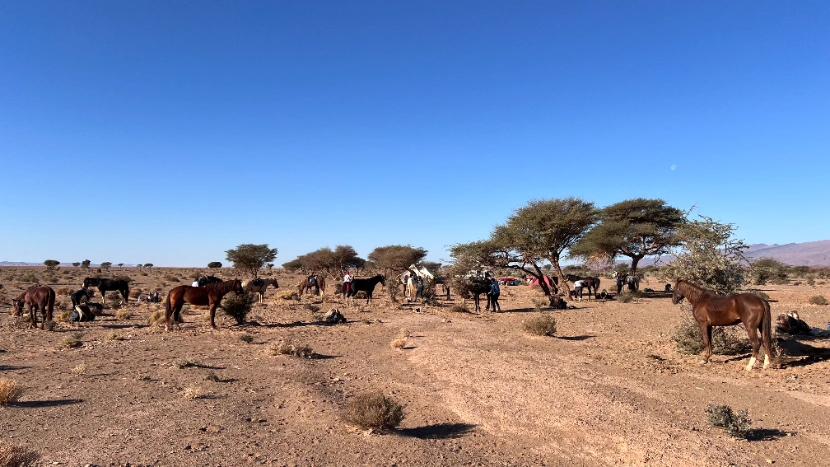
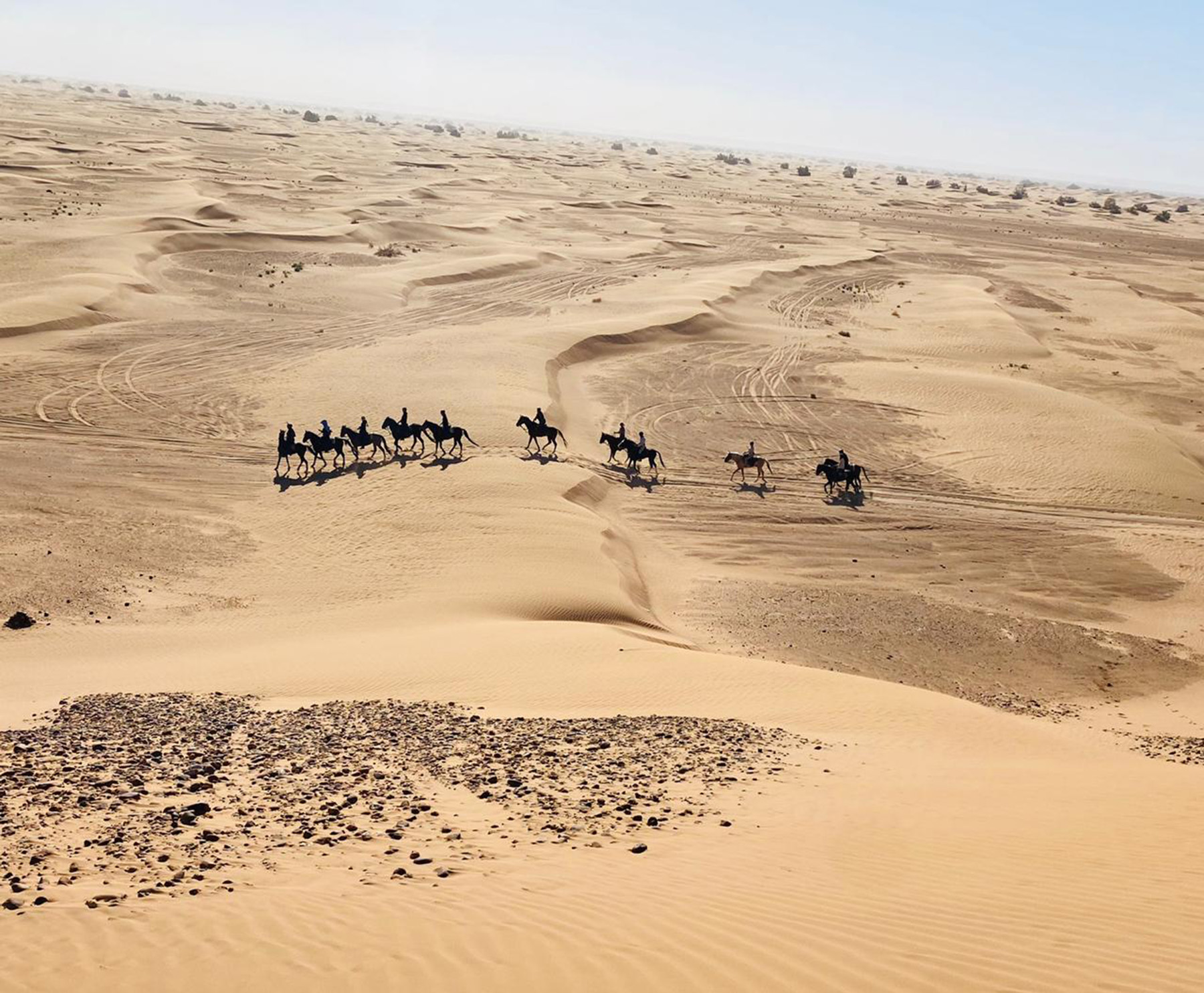
We ride along the Bani mountains — the longest range in Morocco. The landscape is raw, open, and wide. We pass small farms with watermelons, almonds, alfalfa, patches of steppe grass, and low dunes. Everything slowly shifts towards desert.
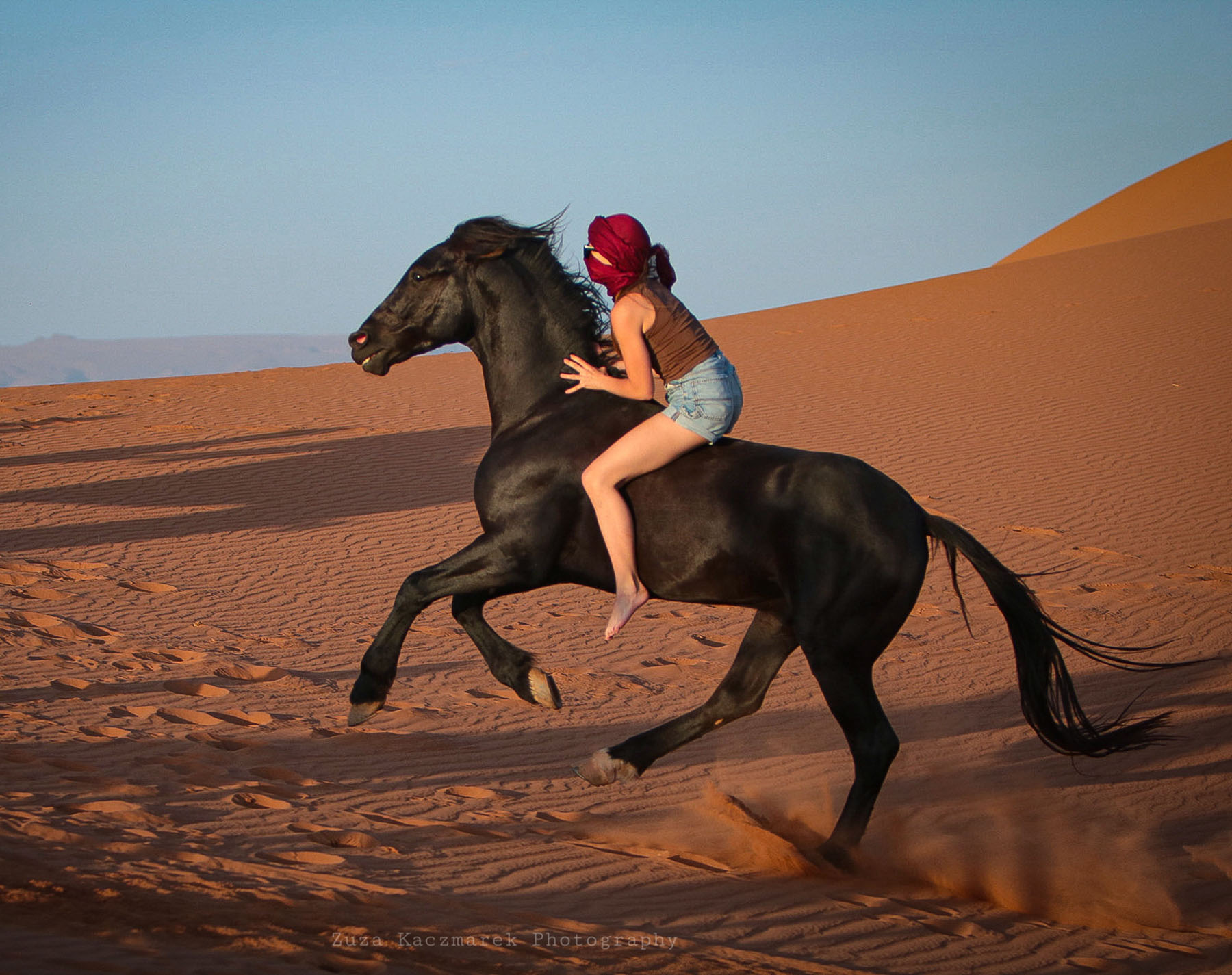
This is the day to get used to your horse and the rhythm of the ride. Mostly walk, some trot, and the first gallops. It’s about finding your balance and understanding how your horse moves out here.
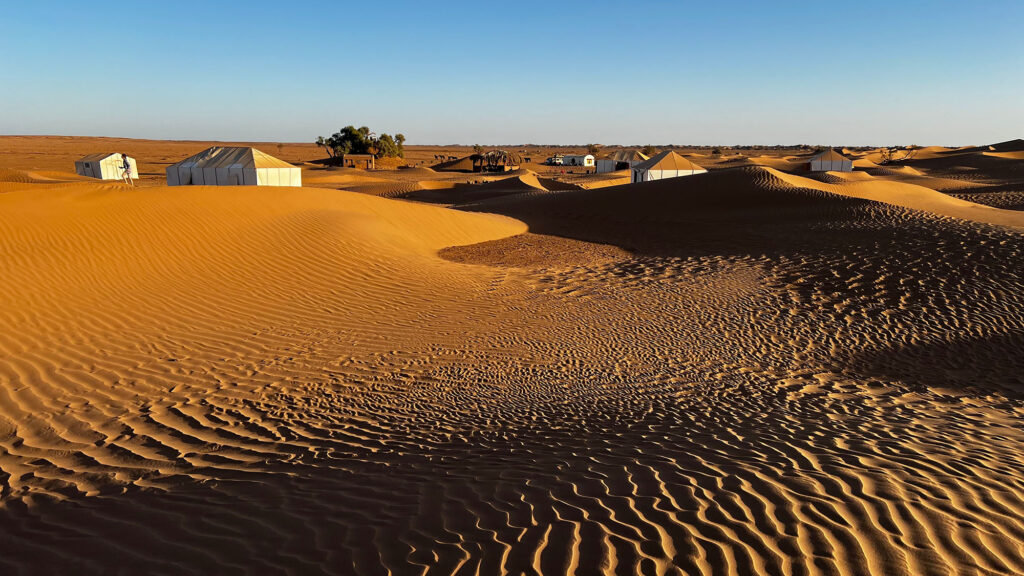
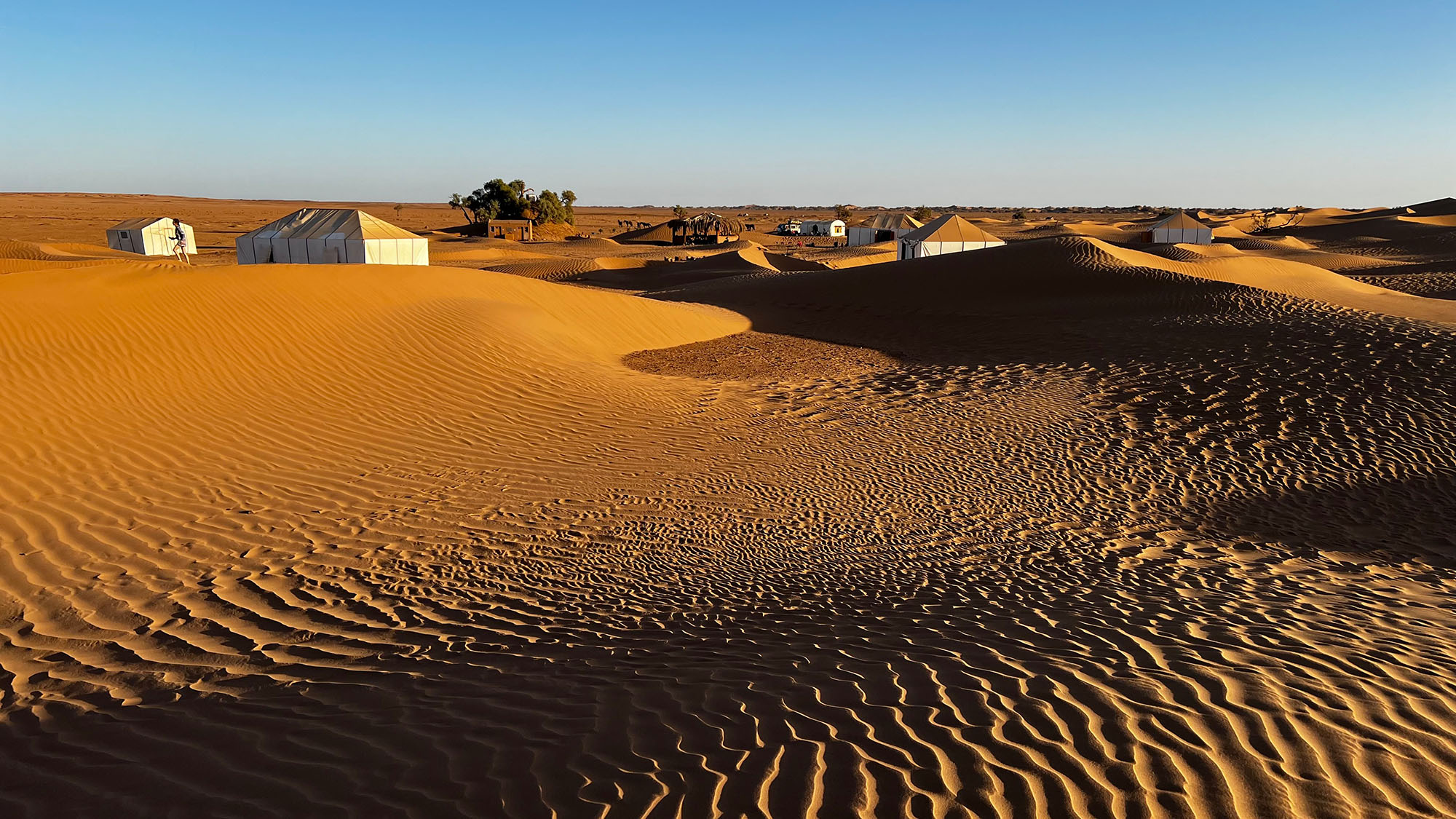
We spend the night in a camp set among small dunes.
Day 4 — Through dunes and mountains
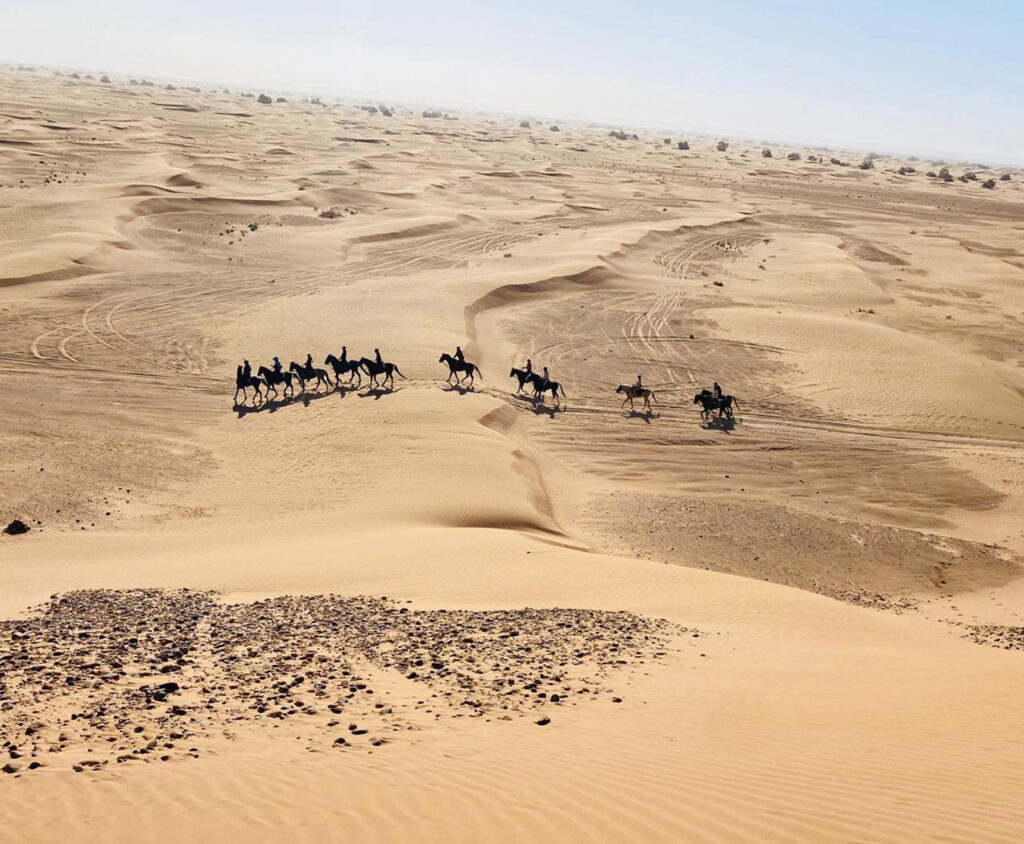
We start in the dunes. A few gallops to warm up, to find the rhythm of the day.
Then we move towards the mountains. We cross to the other side of the range — slow, step by step. At the top, the view opens up: hamada stretching out ahead, another line of mountains in the distance. The space gets bigger, the landscape more raw.
And we keep going — through passes, rocky paths, and open ground.
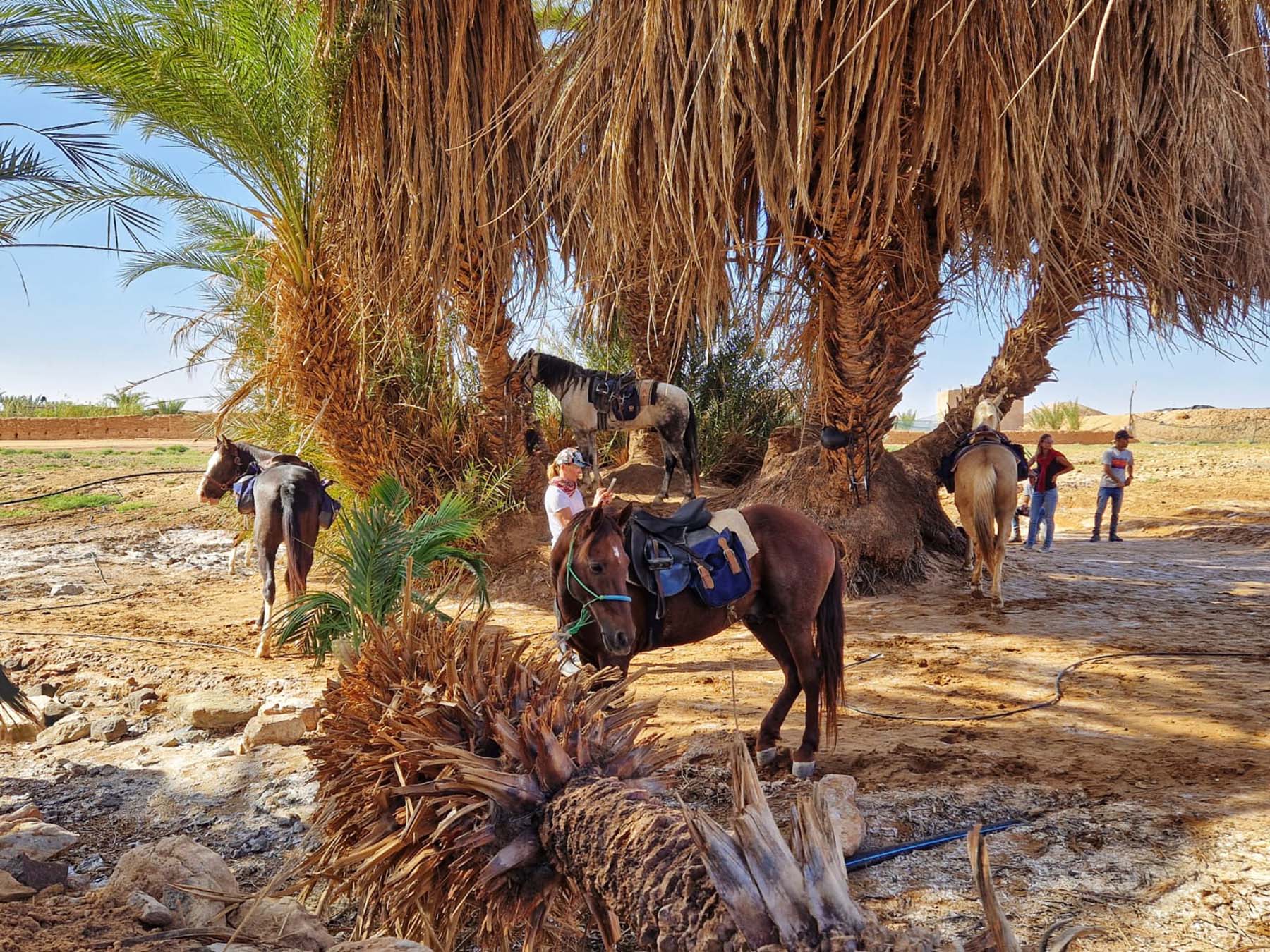
By the end of the day, we reach a camp set in an oasis. It looks like a dry canyon, laid out with large stone slabs, as if shaped by water long ago. The river is gone, but small pools remain, full of frogs. One of those places that clearly used to hold much more water.
This was once a caravan stop — a place to rest on the desert route. Date palms grow all around. There’s a local rule: you can eat a few dates here, but you don’t take them away. The place gives, but isn’t meant to be emptied.
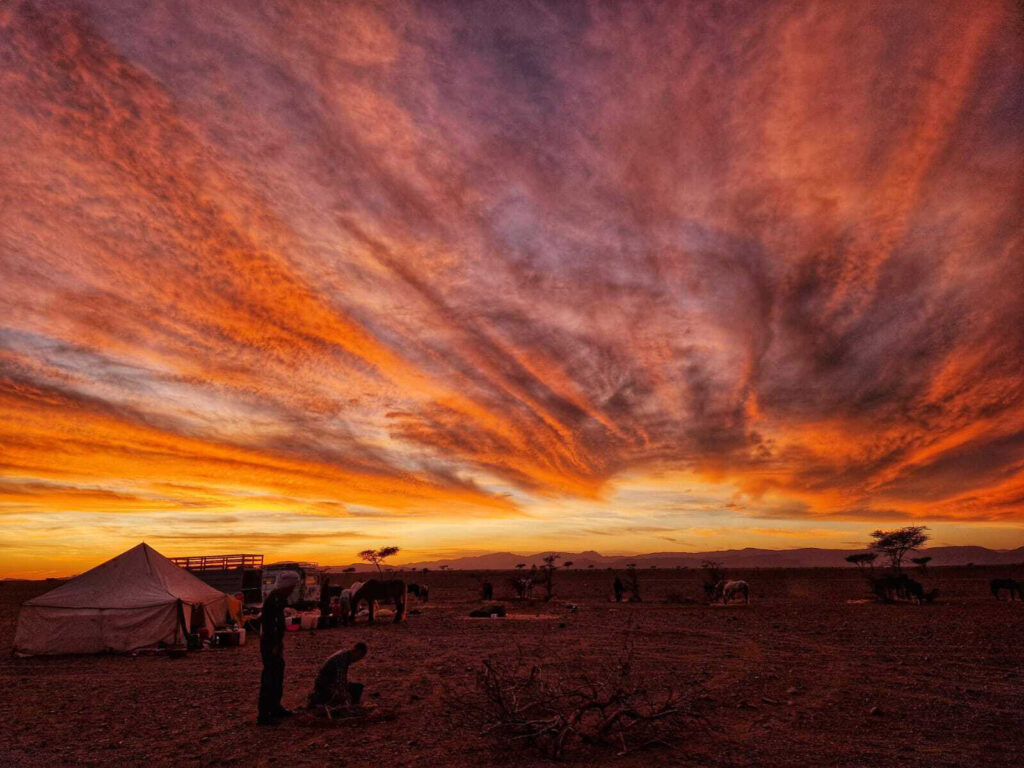
In the evening, we light a fire. Dinner among the palms, cooler air, the moon rising slowly behind the hills.
One of those nights when everything slows down — just fire, horses, and the desert.
Day 5 — From rock to sand
We start on the hamada, but slowly leave the rocky desert behind and move towards the sands.
The landscape is wide and raw — carved gullies, mountain ranges on the horizon, light and space everywhere.
After lunch, the ground begins to change. We move onto firmer tracks, pass scattered nomad settlements and small oases. Another shift.
We reach a temporary water basin, often dry. Sometimes there’s water, sometimes only traces — cracked earth, bird tracks, signs of gazelles. It draws animals from all around. You never quite know what you’ll find here.
By the end of the day, we arrive near Erg Chigaga — one of the largest and wildest dune areas in Morocco. Less accessible than Merzouga, and that’s exactly why it stays raw and empty.
The dunes here are huge — some rising tens of meters — with flat stretches between them that used to be the bottom of an old lake.
We camp at the foot of a large dune, in Berber tents.
Beds, a shower, hot water — after days out, it feels like real luxury.
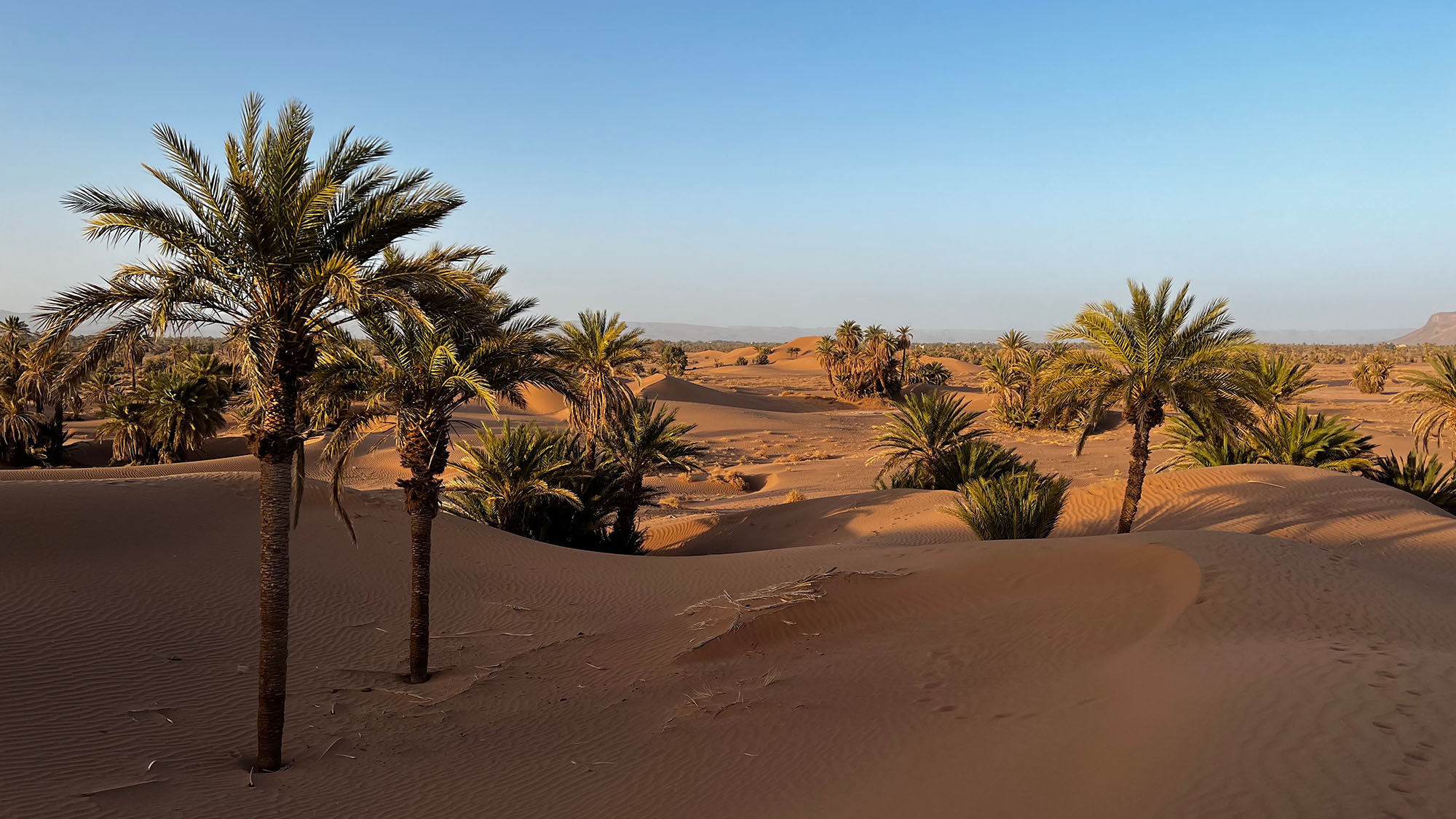
Day 6 — Among the dunes
A slower day. The horses rest, and we stay in the dunes.
No distance to cover, no rush — just time to be in this landscape.
In the morning, we head out on camels. We move between the dunes without a fixed plan, just following the space. If you manage to wake up for sunrise, you’ll see the desert come alive — more sound, birds appearing, wind moving the sand, colours shifting minute by minute.
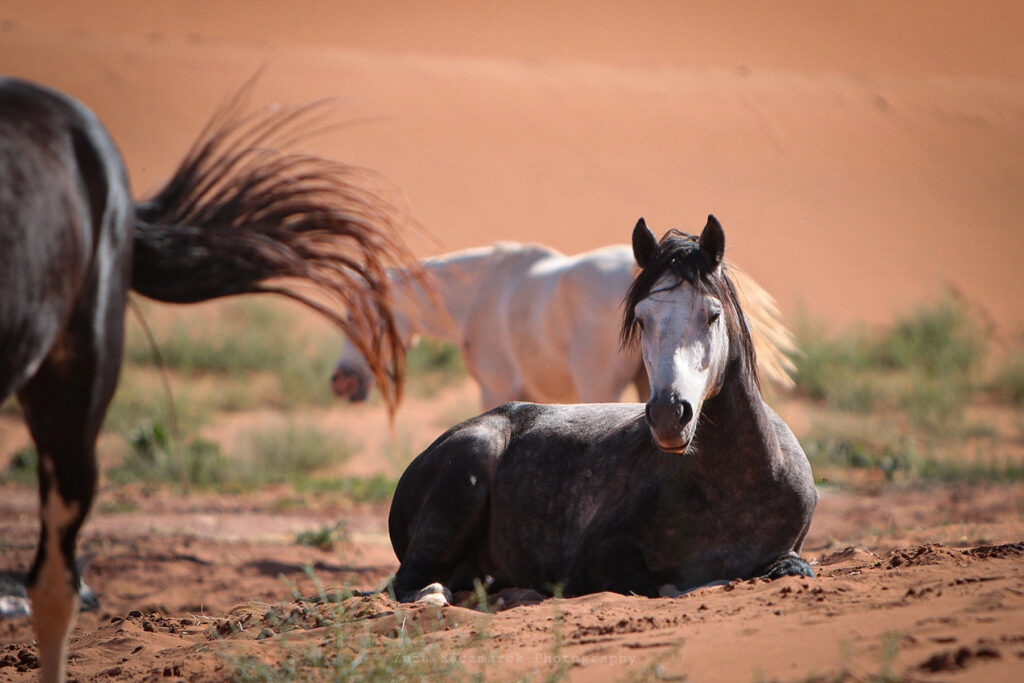
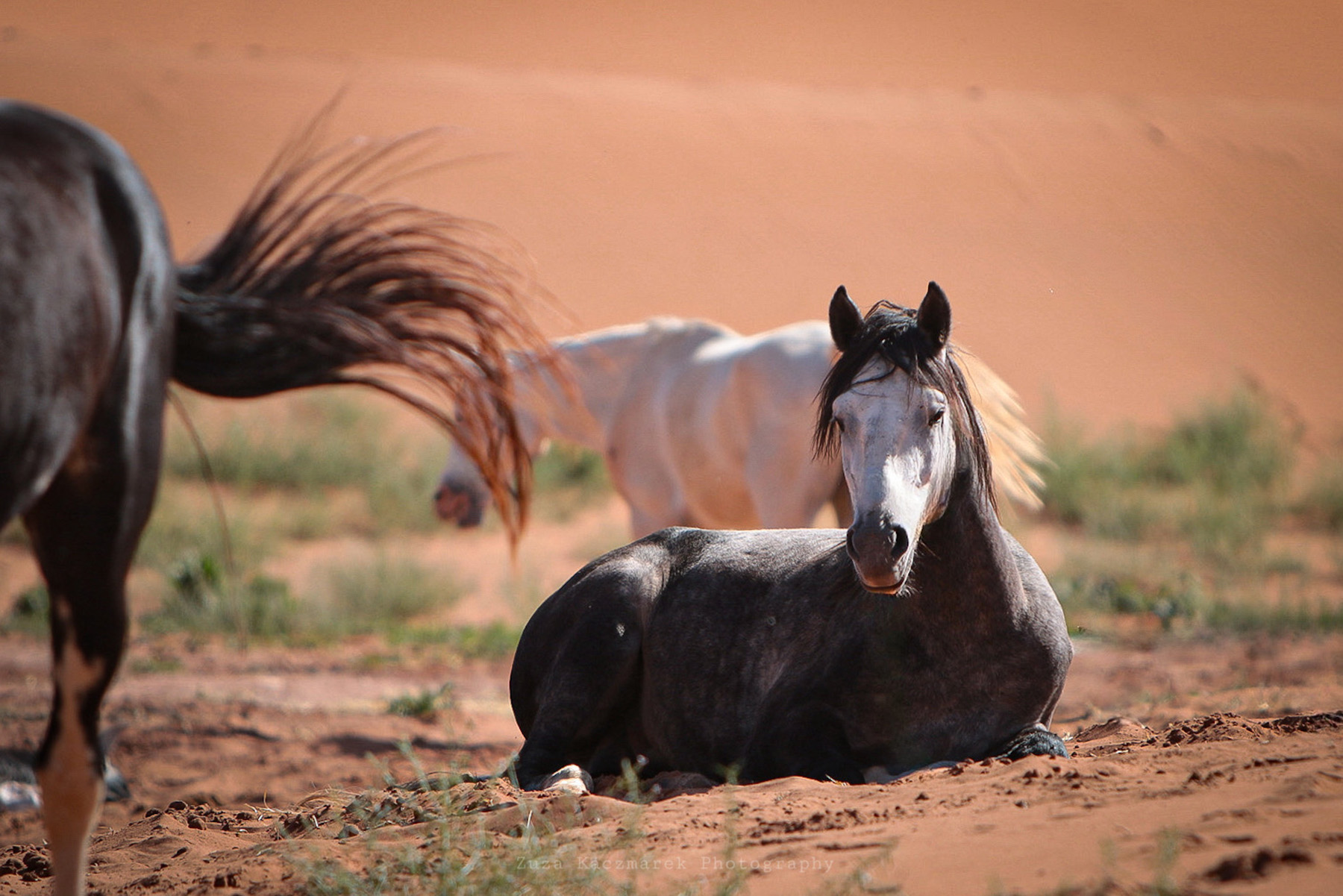
In the afternoon, we spend time with the horses. No pressure — photos, quiet moments, getting close to them without a plan.
For those who want — sandboarding. Sliding down the dunes, some laughter, sand everywhere.
We stay another night in the same camp. Beds, hot shower — after a few days out, it matters.
Day 7 — Endless space
Acacia trees, sand, stone, and wide open ground. The landscape is raw and exposed. Sometimes you’ll spot antelopes grazing. Otherwise — space, light, nothing else.
We ride for a long time through open terrain, with no clear reference points. One of those days when you really feel the scale of the Sahara — how spread out everything is.
By the end of the day, we reach camp.
There’s a good chance we’ll see ostriches around — curious, bold, not too concerned about us.
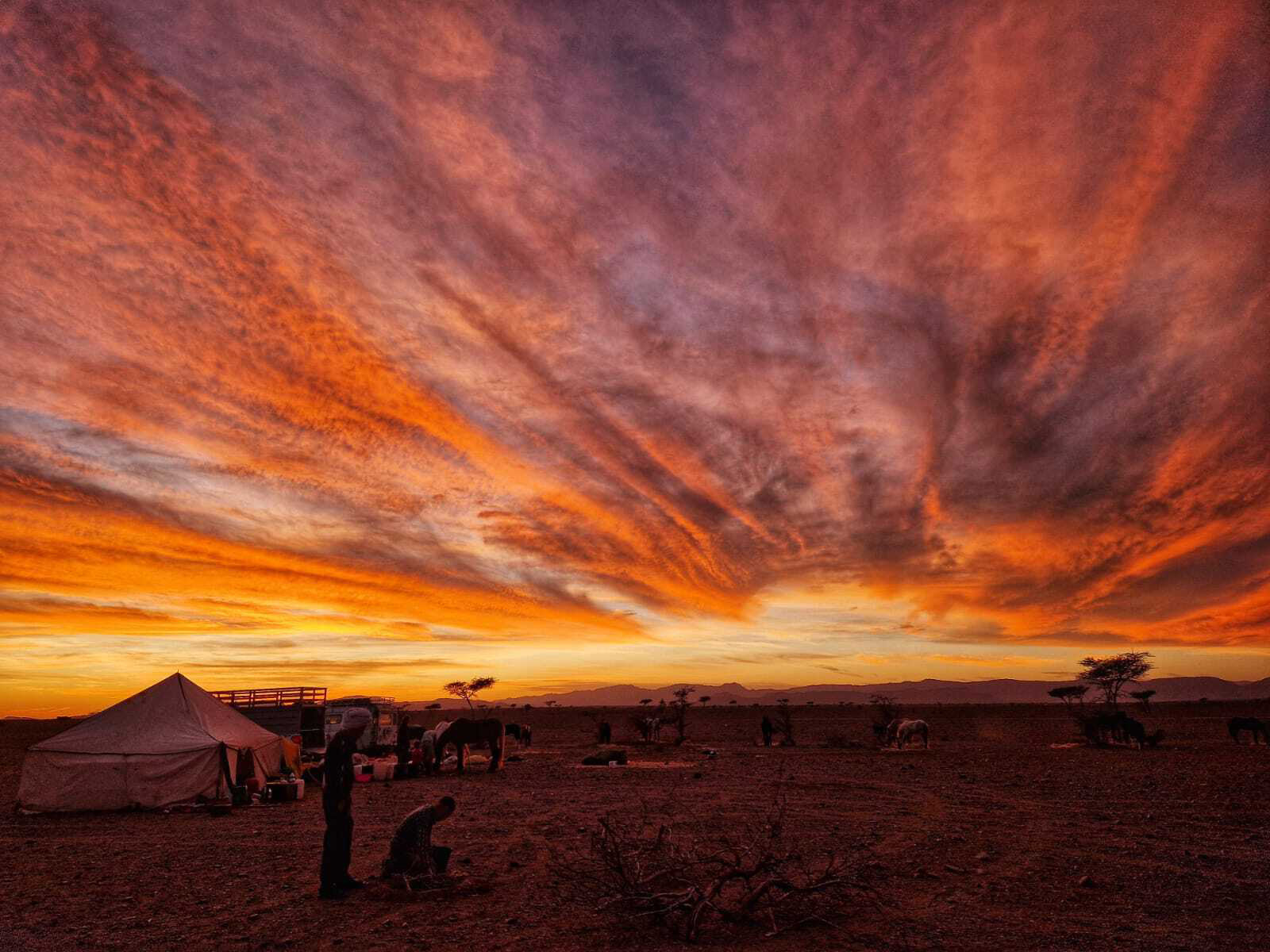
In the evening, we light a fire. Dinner under the open sky. Wind carrying sand and smoke. The temperature drops quickly.
Stars above, silence around.
The desert shifts again.
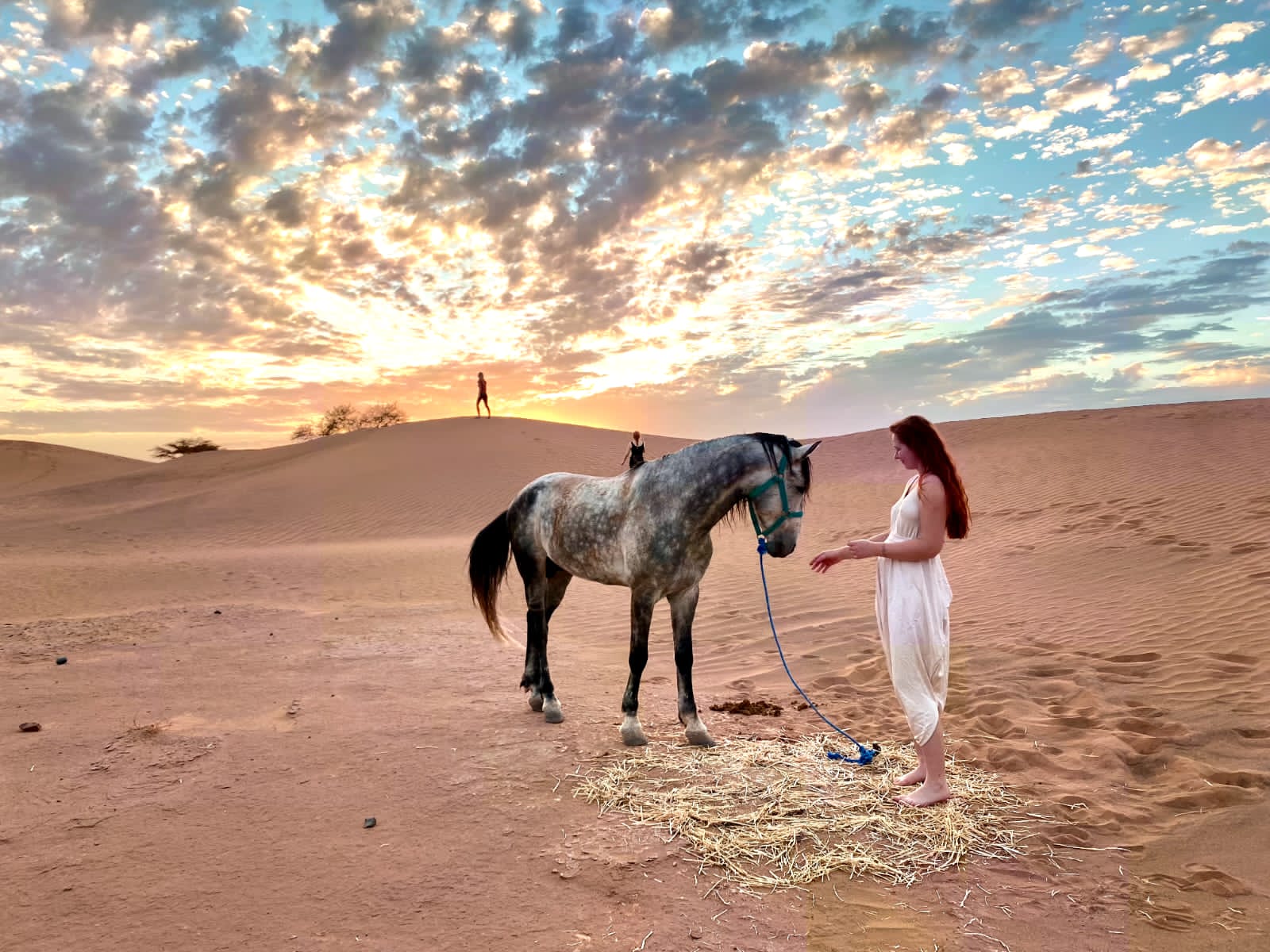
Day 8 — Over the pass
We look for a way through — a pass to get to the other side of the mountains. A day of changing terrain, shifting tracks, and choosing the best route as we go.
Lunch under tamarisk trees, not far from nomad settlements. When visitors pass through, women sometimes bring out what they have — scarves, small handmade things, simple toys made by their children. Nothing fancy, but worth stopping for. It’s direct support for the people who live here.
After lunch, we continue on foot. We lead the horses through the mountains, taking it step by step.
At the top — the view.
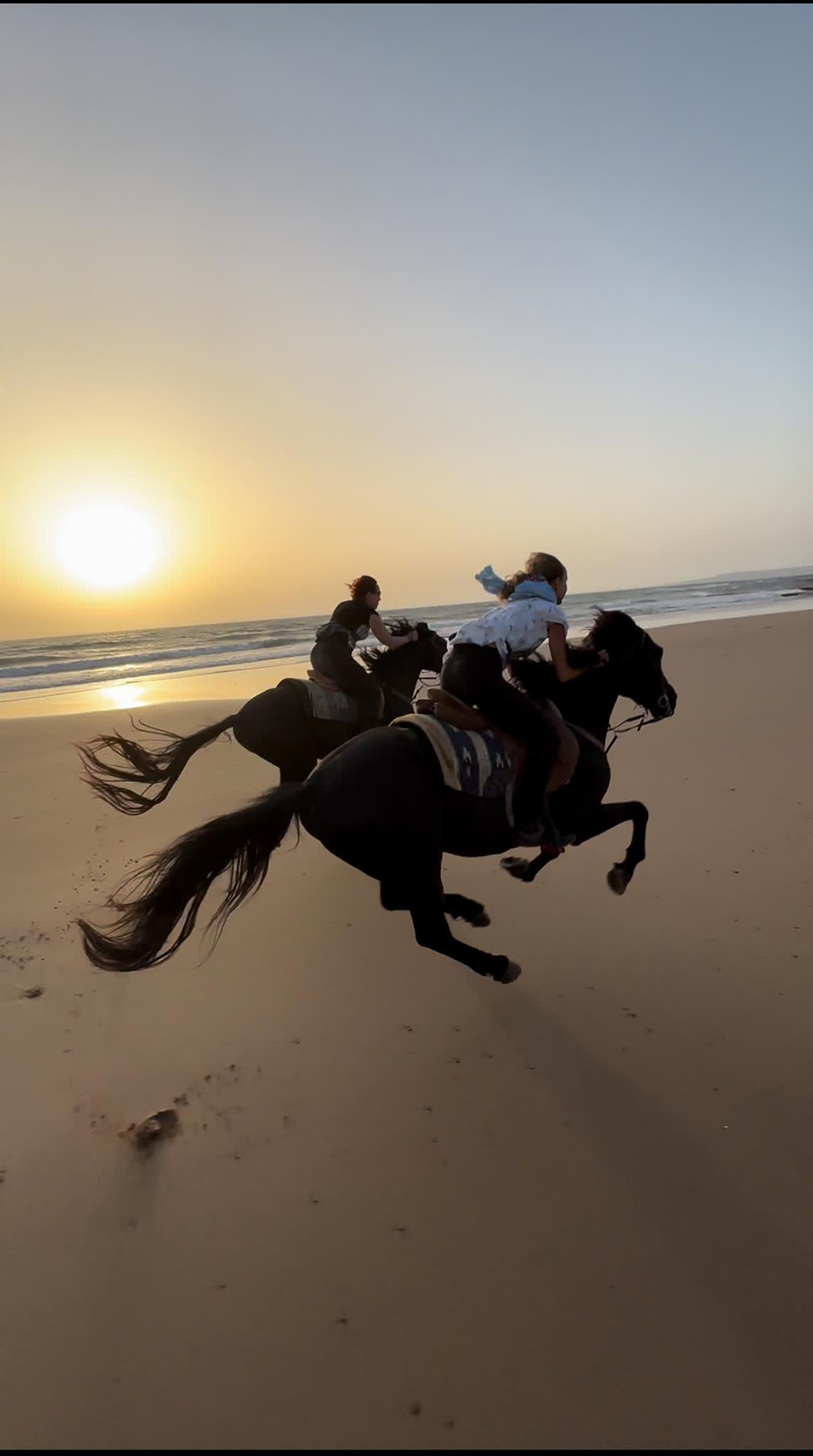
And then a long gallop down towards camp, with the sun going down behind us.
One of those days that stays with you.
Day 9 — Back to Zagora
Last stretch back to Zagora.
Today is shorter — we ride until lunch — but it’s more intense.
More gallops. Narrow village paths, some trot, a river crossing. A mix of everything we’ve seen along the way — desert, people, animals, dust, space, speed.
We reach the stable.
That’s where the riding part ends.
The afternoon is yours. A local hammam if you want, a walk through Zagora, a beer by the pool, or just lying down and doing nothing.
In the evening, dinner together at the hotel. A moment to slow down and let it all settle after the days out in the saddle.
Day 10 — Last stop
Our last stop is Aït Ben Haddou — one of the most cinematic places in Morocco.
For years, it’s been used as a film set. Places like this, preserved so well, are rare. No one knows exactly when it was built, but it was already there in the 16th century.
Walking through its narrow streets, you start recognising scenes from films and series.
A quiet moment — for a walk, photos, and a last look at this landscape. Raw, clay-built, unmistakably Moroccan.
In the evening, we return to Marrakech.
Day 11 — Return
Time to sleep in, have a slow breakfast, and head to the airport.
In total, we’ve covered around 200 km on horseback.
What stays is the space, the light, the wind — and that desert rhythm that’s hard to shake off.
Back home.
What to bring
- Basic first aid kit (painkillers, diarrhea medications, plasters, disinfectants)
- Sunglasses
- Sunscreen with SPF 50+
- Sleeping bag – preferably with a comfort temperature around 0 C
- Passport – valid for at least 3 months after your arrival in Morocco
- Cash – euros are the easiest currency to exchange
- Power bank – no electricity during parts of the trips
- Headlamp – highly resommended
- Clothes – warm layers for mornings, evenings and nights. Comfortable clothes thata are easy to put on and take off while riding are best. A hat is also welcome on colder evenings
- Rain jacket or waterproof layer
- Cap or other sun protection for your head if you will not be riding with a helmet